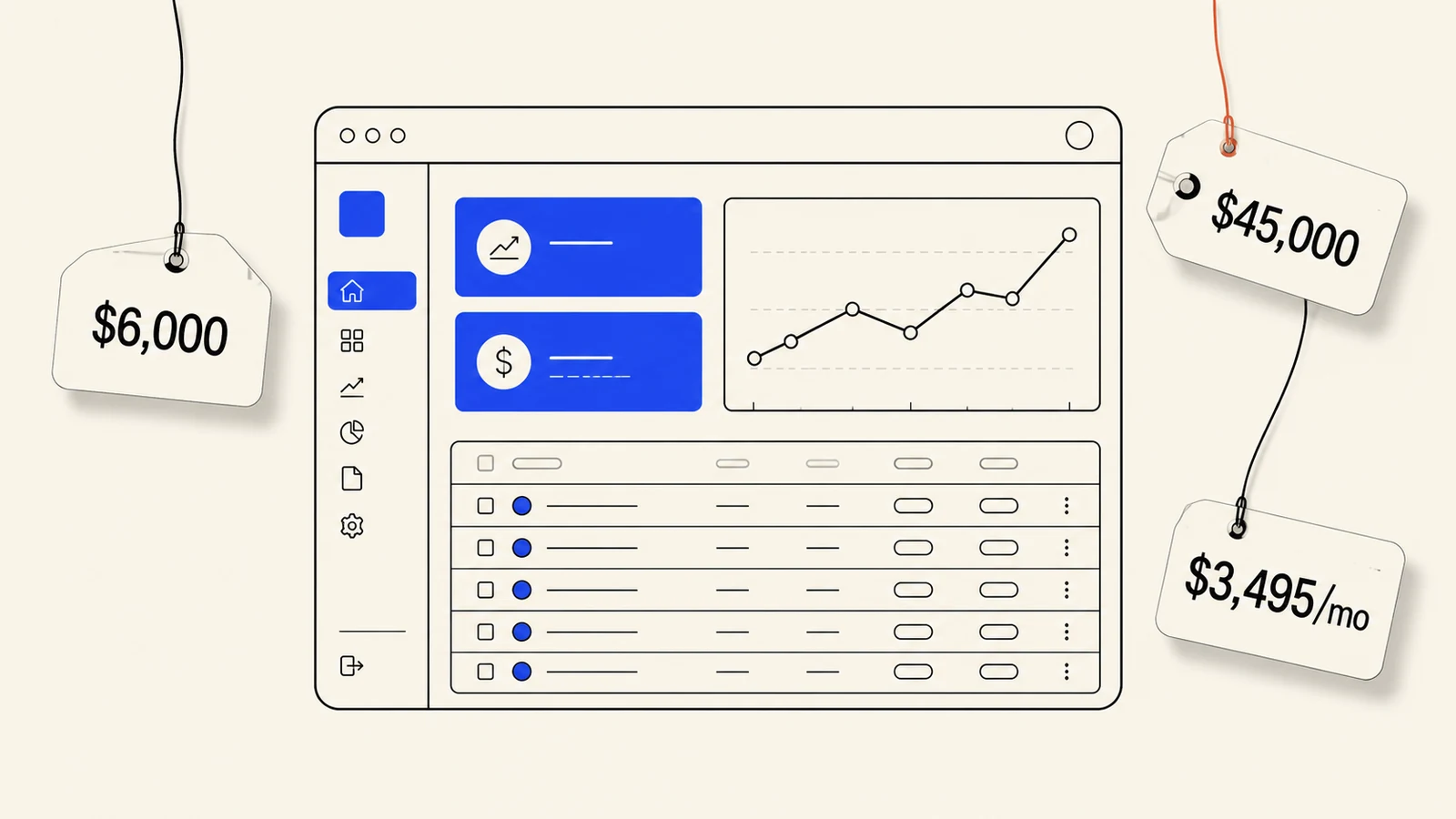
We sell dashboard design, so read this knowing that. It also means we see the quotes founders bring us, and they are all over the place. The same 12-screen dashboard gets quoted $6,000 by a freelancer, $45,000 by an agency, and “let’s hop on a call” by everyone else.
None of those numbers is wrong. They are prices for different things wearing the same name. This post breaks down what you are actually buying at each price, using published 2026 rates, so you can tell which quote fits your situation before you spend a month finding out.
Why the quotes vary this much
Published 2026 numbers first. Freelance product designers charge anywhere from $50 an hour at mid level to $200+ at senior level. US agencies run $100 to $250 an hour, and Clutch’s 2026 pricing data puts most mid-market UI/UX specialists at $100 to $149. A standalone dashboard project typically lands between $5,000 and $20,000, and US agency quotes for a full SaaS dashboard commonly reach $20,000 to $80,000.
So the honest range for “design my dashboard” spans 16x. That is not vendors being greedy at the top or desperate at the bottom. The spread comes from what each one includes, and the biggest cost driver is invisible in every portfolio.
What actually drives the price
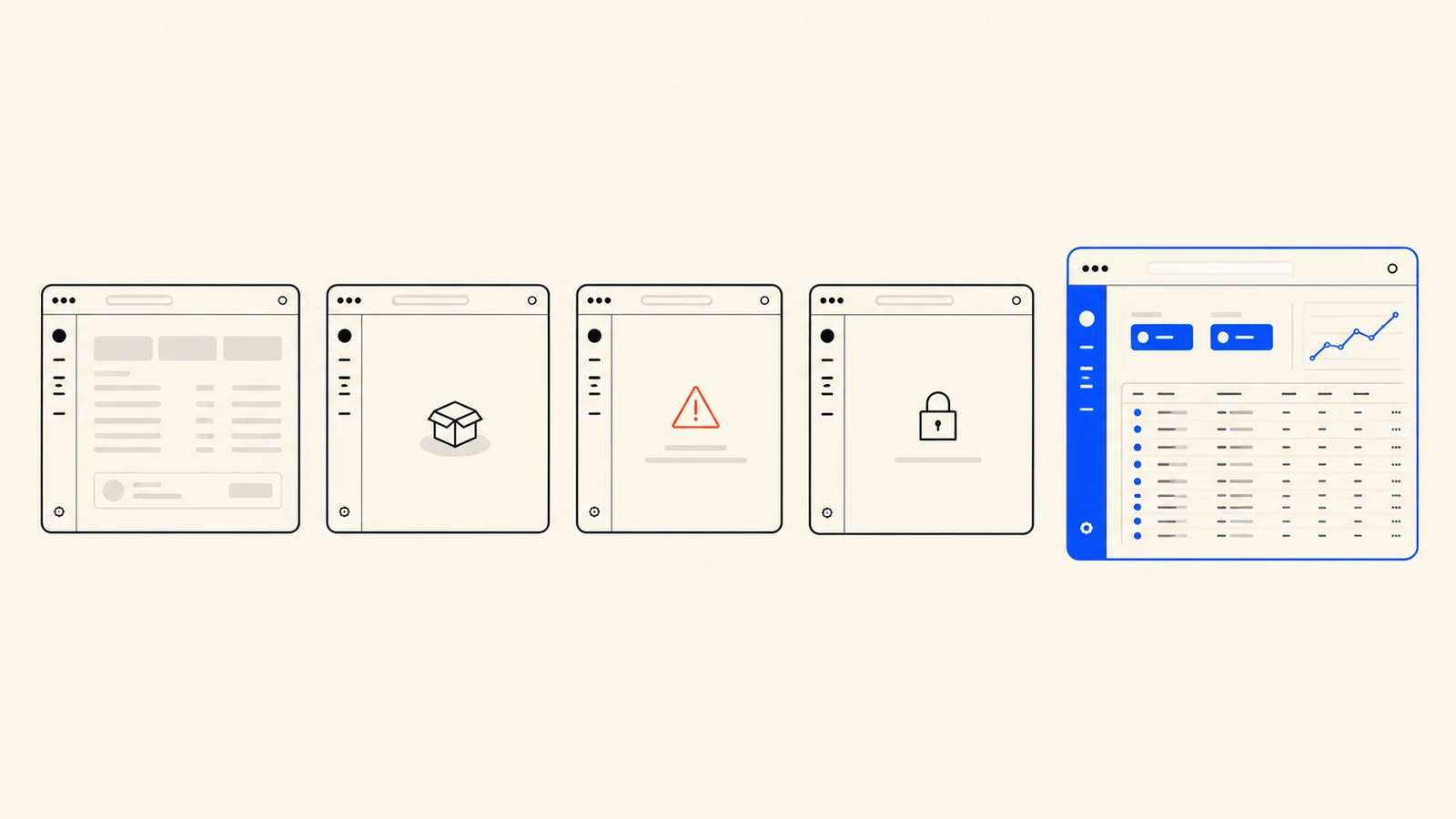
A dashboard is not a screen. It is a system of states, and the states are where the money goes.
The happy-path mockup with clean placeholder data is maybe 20% of the work. The rest is what happens when the table has zero rows, when it has 10,000, when the query fails, when the user is on the wrong permission level, when the date filter and the search filter fight each other, and when all of that has to hold on a laptop screen in a conference room.
A $6,000 quote usually covers the happy path. A $45,000 quote usually covers the system. When two quotes look wildly apart, ask both vendors one question: “show me the empty states and error states in your last dashboard project.” The cheap quote often goes quiet.
Three other multipliers worth knowing:
Data density. A marketing dashboard with four KPI cards is a different product from an ops table with 30 columns, inline editing and saved views. Per-screen pricing treats them the same, which is why per-screen pricing is a trap.
Roles and permissions.Every user role multiplies the states. Admin, member, read-only and billing-owner views of the “same” screen are four screens.
Who owns the design system. If component decisions are made per screen, you pay for them per screen, forever. If there is a system, screen 12 costs a fraction of screen 1.
What that system costs on its own is a separate question with its own price list, from a 30 component starter library to a governed enterprise build. We broke the 2026 numbers down in what a design system costs.
The four ways to buy it
Here is the 2026 market, honestly, including where we sit in it.
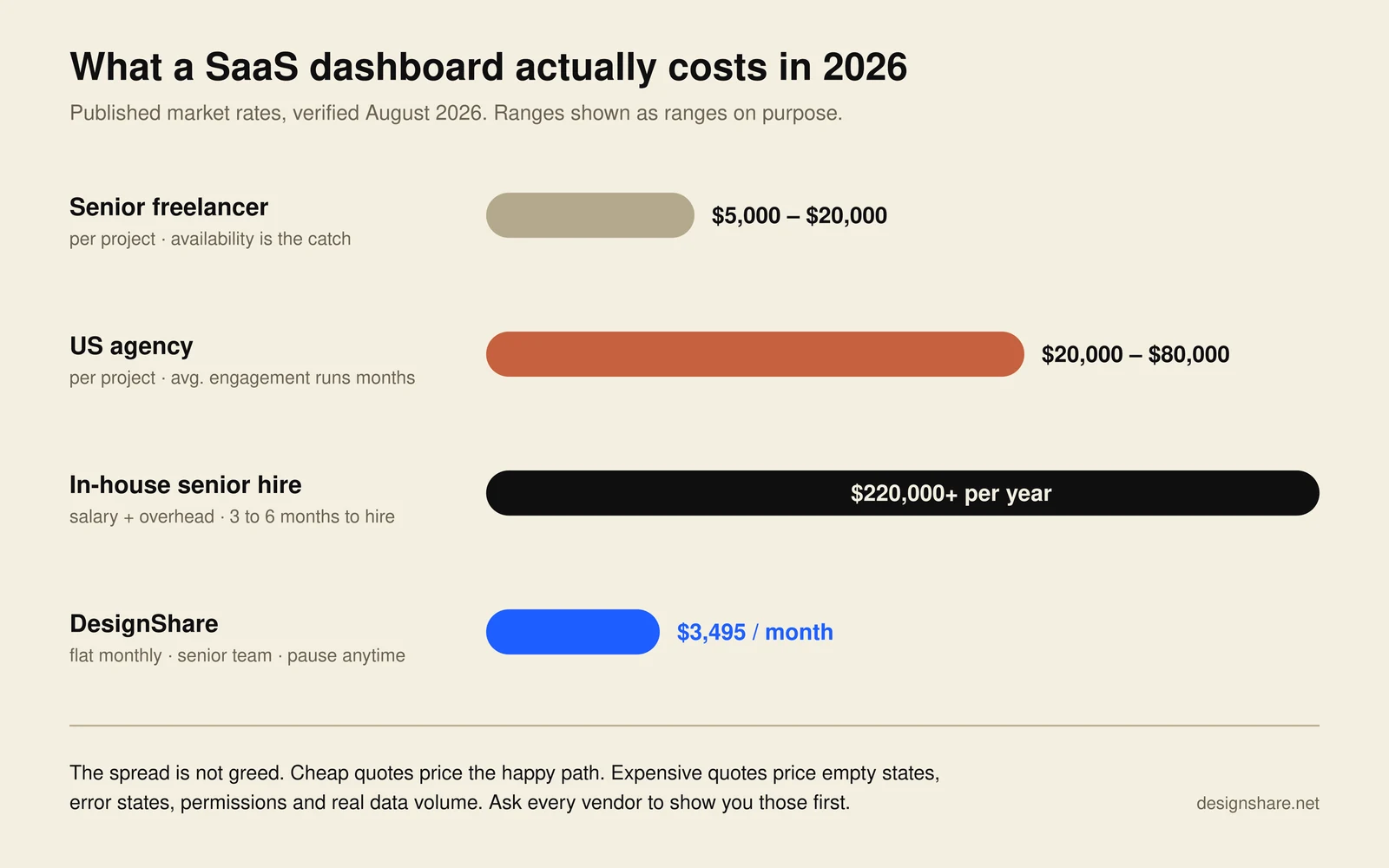
Route 1: A freelancer, $5,000 to $20,000 per project
The right senior freelancer is the best value in this list. The problem is the word “right”. Seniors with real dashboard work are booked out, and the available ones are mostly marketing designers who will make your dashboard beautiful and unusable at 10,000 rows.
Fits: you have one contained project, you can vet portfolios for real product work, and your timeline can absorb their availability.
Risks: no backup when they disappear mid-project, and the design system usually leaves with them.
Route 2: An agency, $20,000 to $80,000 per project
You get process, a team, and accountability. You also get the agency cost structure: discovery phases, strategy decks, and a 10-month average project timeline across the industry. For an enterprise platform with compliance requirements, that overhead is the product. For a 15-person SaaS that needs the admin panel fixed this quarter, it is mostly weight.
Fits: enterprise scope, multiple stakeholders, compliance, big budgets.
Risks: the meter runs on hours, so every revision is a negotiation, and the timeline is measured in quarters.
Route 3: Hiring in-house, $220,000+ per year
A senior product designer’s US salary most commonly lands between $170,000 and $230,000, and the loaded cost with benefits and overhead runs roughly 1.3x that. Plus three to six months to hire, and the risk that one person covers product UI, marketing pages and everything between.
The in-house hire is correct once design is a continuous, daily need. Most companies under 50 people are buying a full-time seat for a part-time need. We wrote up the full math in design subscription vs hiring vs agency if you want it line by line.
Fits: design work every single day, product complexity that needs deep context.
Risks: $18,000+ a month before the first screen ships, and a bad hire costs two quarters.
Route 4: A subscription, $3,495 a month, flat
This is us, so here is the case plainly. DesignShare is a senior designer, a web designer and a project manager for $3,495 a month, one active request at a time, about 48 hours per request, pause or cancel whenever you want. Dashboards, admin panels, internal tools and onboarding flows are most of what we do, designed against your real data shapes so the screen still works at 10,000 rows.
The honest trade-off: one active request at a time means a full 40-screen platform redesign moves in daily slices, not in one parallel burst. If you need six designers sprinting in parallel for a quarter, that is agency work. If you need a steady senior team shipping product screens every 48 hours at a known monthly cost, that is what the model is for.
One client data point instead of adjectives: MDsyncNET had their onboarding redesigned on this model and trial-to-paid conversion went from 18% to 34% in two weeks.
The math against the other routes: three months of subscription is $10,485. That sits at the bottom of the agency range, buys roughly 45 delivered requests instead of one scoped project, and costs about half of one month of a loaded in-house senior. If the category interests you, we compared every major player’s live pricing in the DesignJoy alternatives breakdown.
The cheapest option nobody prices: doing nothing
Your dashboard was designed by someone. An engineer with a component library, a marketing designer between landing pages, or nobody at all. That version feels free because no invoice arrived.
It is not free. Churn concentrates in exactly those screens, because the dashboard is where your customers live after the marketing site convinced them. And a redesign after launch costs roughly 3 times what designing it properly would have, because now every change fights shipped code and trained users.
How to choose in one paragraph
Count your screens honestly, including states and roles. One contained project and a good eye for portfolios: freelancer. Enterprise scope, stakeholders and compliance: agency. Daily design need and $220k of budget: hire. A real product with a steady stream of screens that need senior hands at a predictable cost: subscription. And whichever route you pick, make the vendor show you empty states and error states from their last dashboard before you sign anything.
If you want the low-risk version of testing us: the $499 UX audit covers up to 10 of your product screens, 20+ annotated findings, delivered in 5 business days, and the full $499 credits toward month one if you subscribe within 30 days.
Frequently asked questions
Want a senior team on your dashboard for a flat $3,495 a month? See the full scope and pricing.